asdasdasda
adasdasdasd
asdasdasd
asdasdas
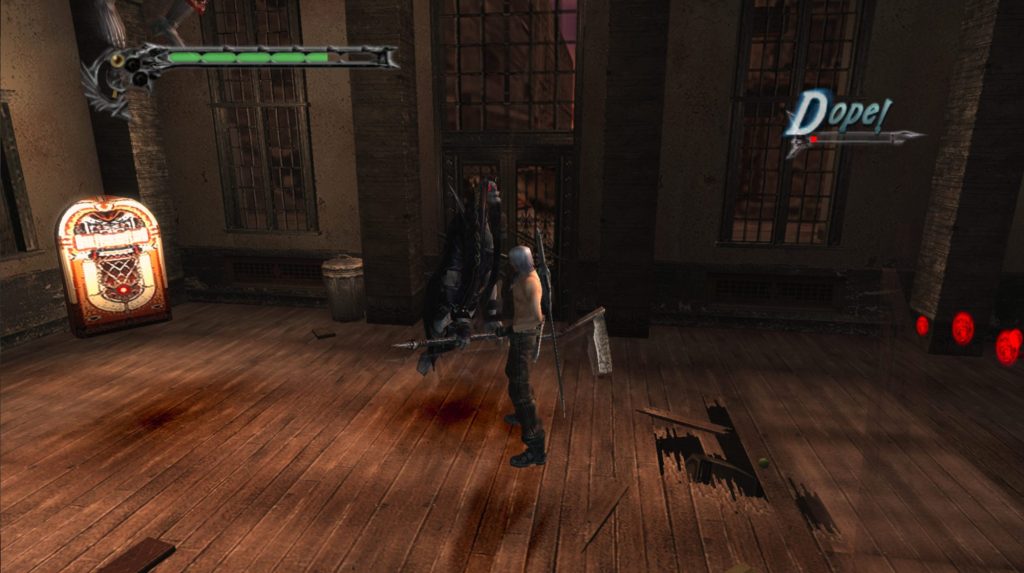
There’s a feeling you get when you’re truly in the zone playing Devil May Cry. It’s a state of flow that transcends simply winning. It’s not just about clearing a room of demons; it’s about how you do it. It’s the percussive rhythm of sword slashes, the punctuation of gunfire, the seamless dance of launching a demon into the air, juggling it with your pistols, and slamming it back to the ground without your feet ever touching the floor. It’s about chasing that flash of text in the corner of the screen, watching it climb from “Dull” to “Cool,” then “Bravo,” “Awesome,” and finally, the explosive, screen-filling declaration: “Smokin’ Sexy Style!!!” That feeling—that pursuit of performance as power—is the very soul of this series.
What’s truly remarkable, looking back over two decades of influence, is that this entire genre-defining franchise was, in essence, a happy accident. It was born from a project deemed a failure, a creative disagreement that could have spelled its end but instead gave it life. The story of Devil May Cry is a series of these fortunate mishaps, of bugs turned into features and setbacks turned into comebacks, all guided by the brilliant vision of developers who understood one fundamental truth: it’s not enough to be a badass; you have to look cool doing it. This is the story of how a rejected concept for a horror game gave birth to the modern action genre, and how its philosophy of stylish combat, rooted in the arcades of the past, continues to shape the games of today.
Part I: The Resident Evil That Wasn’t: A Stylish Accident
The “Cool” Resident Evil 4
Our story begins where you might not expect it: in the hallowed, zombie-infested halls of the Resident Evil franchise. Around 1999, Capcom tasked Hideki Kamiya, the acclaimed director of Resident Evil 2. with helming the next major installment, Resident Evil 4, for the upcoming PlayStation 2. But Kamiya had a vision that was fundamentally at odds with the slow, methodical dread of survival horror. He wanted to create something different, something he described as a “very cool and stylized action-adventure game”.
The initial concept already showed signs of this radical departure. The protagonist wasn’t a familiar face but a new character named Tony, an “invincible man with skills and an intellect exceeding that of normal people,” his superhuman abilities explained away by advanced biotechnology. The gameplay was being built for speed and spectacle. To achieve a more heroic and cinematic feel, Kamiya’s team made a pivotal technical decision: they abandoned the pre-rendered backgrounds that were a hallmark of classic Resident Evil in favor of a fully 3D environment with a dynamic camera system. This new direction was so important that it prompted the team to take an eleven-day research trip to the United Kingdom and Spain, photographing Gothic statues and stone pavements to build the game’s texture library, cementing a commitment to a new, macabre aesthetic.
A New Aesthetic and a Pivotal Disagreement
As the project took shape, it became clear that this was not your older brother’s Resident Evil. It was too fast, too slick, too… cool. This is where series producer Shinji Mikami, a legend in his own right, made a franchise-altering decision. He recognized the quality and potential of what Kamiya’s team was building, but he also felt it had strayed too far from the series’ survival horror roots. Instead of canceling the project or forcing it to conform, Mikami convinced the staff to do something far more daring: make it its own, independent game.
This single decision was the big bang for the Devil May Cry universe. It was not a failure to be a good Resident Evil game; it was the necessary condition for it to become a brilliant Devil May Cry game. The liberation from an established IP unshackled Kamiya and his team, giving them total creative freedom. The result was a game with an uncommonly strong and singular vision that would have been impossible had it remained tied to another franchise’s expectations.
The Birth of Dante and a New Mythology
Freed from the constraints of zombies and corporate conspiracies, Kamiya rewrote the story from the ground up. Biotechnology was out, demons were in. The gothic European architecture they had researched now had a new, supernatural context. Drawing inspiration from the 14th-century Italian epic poem _The Divine Comedy_, Kamiya reimagined his hero. “Tony” became “Dante,” and the game’s world was filled with allusions to the poem, from his brother Vergil (Virgil) to his mysterious ally Trish (Beatrice). A new mythology was born.
Deconstructing “Cool”: The Kamiya Method
What truly defined the game, however, was the highly personal, almost auteur-like vision Kamiya had for his protagonist. Dante wasn’t just a collection of mechanics; he was the embodiment of Kamiya’s specific definition of “cool.” In interviews, he has broken down his method, revealing a fascinating blend of influences.
The core of Dante’s personality came from a perhaps surprising source: the classic manga series _Cobra_ by Buichi Terasawa. Kamiya explained this influence in a 2001 interview:
Even when Cobra fights, he has a little smile on his face, it is cool. But, sometimes Cobra makes a serious face and it makes tension for the readers. Dante too, usually Dante talks to devil like he doesn’t care, but he is carrying sadness and spiteful feelings because his family was killed by devils… so he pretends to be calm and keeps pretends… then in the end, he can’t keep doing it anymore and his story climaxes. ‘The beauty of keeping feelings inside’ is really Japanese way, I think.
Hideki Kamiya, Devil May Cry Graphic Edition (Dec 2001)
This quote is the Rosetta Stone for understanding Dante. He’s not just a wisecracking hero; he’s a character defined by a cool, detached exterior that masks deep-seated trauma—a classic archetype filtered through a distinctly Japanese sensibility.
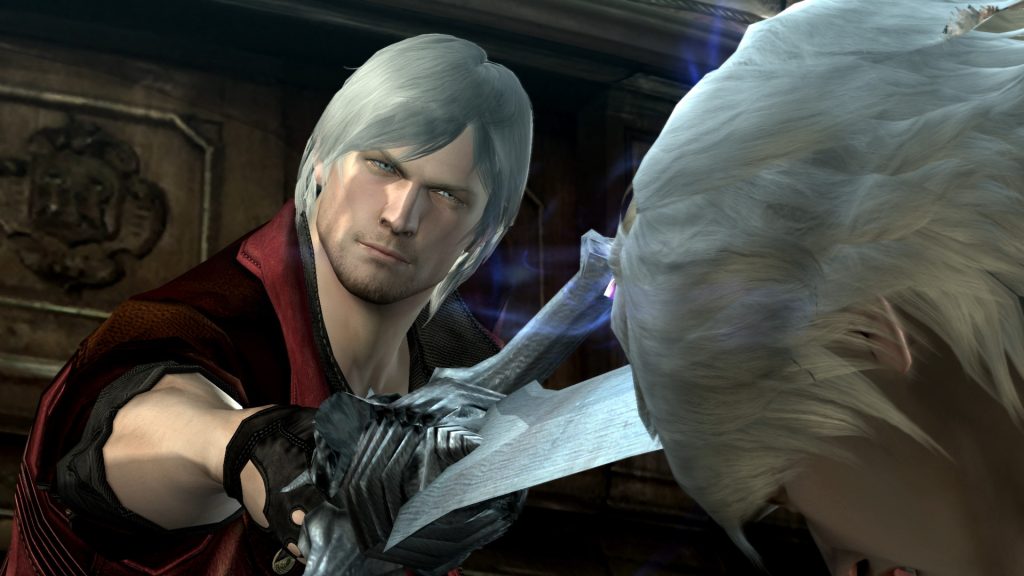
This personal vision extended to every aspect of his design. When briefing his character designer, Kamiya gave three specific focus points: he had to have a long coat to make him look “showy” in motion; he should be a “British guy,” which to Kamiya implied a witty, traditional fighting man, not just a brute; and, crucially, he must not smoke cigarettes, because Kamiya simply thought a “man without cigarette is cool”. His iconic red coat was chosen because red is a traditional color for a heroic figure in Japan.
Kamiya also wanted Dante to feel approachable, not just an untouchable superhero. He envisioned him as “a character that you would want to go out drinking with,” someone who wasn’t a show-off but would instead “pull some ridiculous, mischievous joke” to make people like him.It was this combination of effortless style, hidden depth, and mischievous charm that created one of gaming’s most enduring icons.
Part II: The Arcade in Your Living Room: Forging a Genre
The Accidental Mechanic
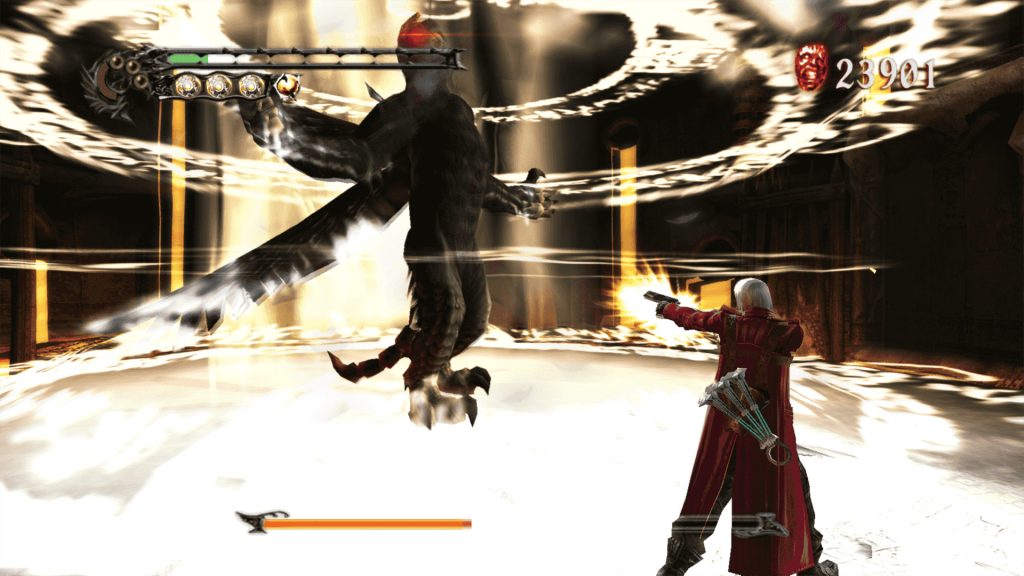
The combat system that would go on to define a genre began, fittingly, with another happy accident. While playtesting another in-development Capcom title, Onimusha: Warlords, Kamiya discovered a bug. This glitch allowed players to keep enemies suspended in the air by repeatedly slashing them. Where others might have seen a flaw to be patched, Kamiya saw the spark of an idea. He took this emergent piece of fun and formalized it, building an entire system around aerial combat. The concept of launching an enemy with a sword and juggling them with gunfire—a move now synonymous with the series—was born from a bug in another game.
Infusing Fighting Game DNA
This discovery opened the floodgates for Kamiya and his team, many of whom came from Capcom’s legendary fighting game division, to infuse Devil May Cry with the DNA of their arcade pedigree. They systematically translated the depth and precision of 2D fighting games like Street Fighter into a 3D action space, a revolutionary move at the time.
This was achieved through several key innovations. First, the game borrowed core fighting game concepts wholesale: launchers to send enemies airborne, juggling to keep them there, and aerial combos to punish them. Second, the R1 lock-on system was a stroke of genius. It effectively snapped the player and their target onto a 2D plane, allowing for the kind of precise, directional inputs required for complex special moves—something notoriously difficult to pull off in a free-roaming 3D environment. A perfect example is Dante’s “Stinger” attack, a lunging sword thrust that closes distance in an instant. It functions as the 3D equivalent of Street Fighter‘s iconic Shoryuken: a high-commitment, high-reward move that is incredibly powerful when used correctly but leaves the player wide open if it misses.
Perhaps the most crucial innovation, however, was mapping Dante’s melee and ranged attacks to separate buttons. This simple decision allowed players to seamlessly weave swordplay and gunplay together, creating a freeform, expressive combat system that was unlike anything that had come before it.
The Philosophy of the Style Meter
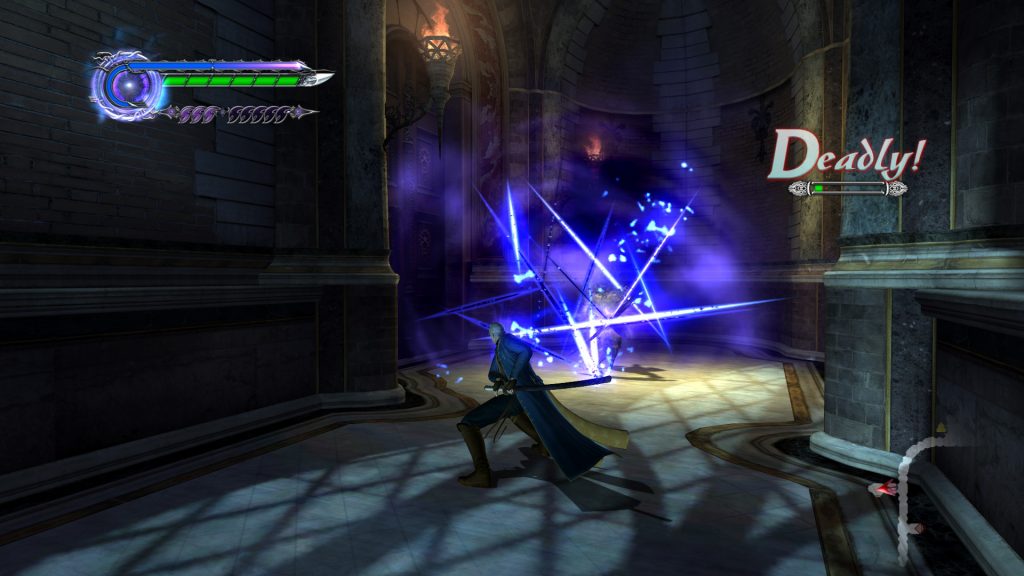
If the combo system was the body of Devil May Cry, the Style Meter was its soul. This was more than just a scoring system; it was a feedback mechanism designed to teach and encourage players to engage with the game’s full mechanical depth. It actively discourages button-mashing by rewarding variety and penalizing repetition and taking damage.
The inspiration for this system came directly from Kamiya’s personal history with arcades. He was fascinated by the social culture of the arcade, specifically the way a crowd would form around a skilled player who was putting on a show. As he recalled:
[…] he saw crowds gathering around a cabinet to watch someone on a good run. The more the player took risks and showed off, the bigger the crowd would become. This gave Kamiya the idea for the real-time grading system that Devil May Cry uses.
Bloody Disgusting, As ‘Devil May Cry’ Turns 20, Bloody Disgusting Revisits its Origins and Influences (August 23, 2021)
The Style Meter is a digital recreation of that social feedback loop. It’s the game’s way of being that crowd, cheering you on when you’re playing with flair and pushing you to do better when you’re not. This holistic system—an inspiring hero, a deep set of expressive tools, and a feedback loop that rewards performance—is the true invention of Devil May Cry. It established a design philosophy centered on player expression through combat, which is why so many games influenced by the series feel different; they may borrow the mechanics, but not all of them capture this core philosophy of performance.
The Birth of “Character Action”
This unique combination of mechanics and philosophy didn’t just make for a great game; it codified a new subgenre. Often called “character action” or “stylish action,” this genre is defined by its focus on deep, combo-based combat, real-time performance grading, and larger-than-life protagonists. The influence of Devil May Cry is vast and undeniable. It laid the groundwork for titans like God of War, which amped up the spectacle; Bayonetta, Kamiya’s own spiritual successor; and countless others, from Nier: Automata to the recent Final Fantasy XVI, whose combat director, Ryota Suzuki, is a Devil May Cry veteran.
Part III: A Difficult Second Album and a Legendary Redemption
The Follow-Up: A Change in Direction
After the breakout success of the first game, a sequel was inevitable. However, Devil May Cry 2 was put on a fast track to capitalize on the original’s popularity, and development was handed to a different, less experienced team within Capcom Production Studio 1. Hideki Kamiya and the original “Team Little Devils” were not involved; in fact, Kamiya didn’t even know a sequel was being made until late in the process.
This new team, under an unnamed director, took the series in a different direction. One of the most significant changes was to Dante’s character. A producer on the project reportedly disliked the “joke-cracking wiseass” of the first game and pushed for a more “grown-up and taciturn” protagonist. This, combined with larger but blander environments and a combat system that didn’t build upon the original’s depth, led to a final product that didn’t receive the same level of acclaim as its predecessor.
Itsuno to the Rescue
The development was reportedly so troubled that with only a few months left before release, Capcom brought in Hideaki Itsuno, a veteran director from their fighting game division, to salvage the project. Given the extremely short timeframe, Itsuno and his team did what they could to ship a playable game. This context is vital; it reframes Devil May Cry 2 not as a simple creative misstep, but as a product of a difficult development cycle that Itsuno admirably saw through to completion.
The Phoenix from the Ashes: Devil May Cry 3
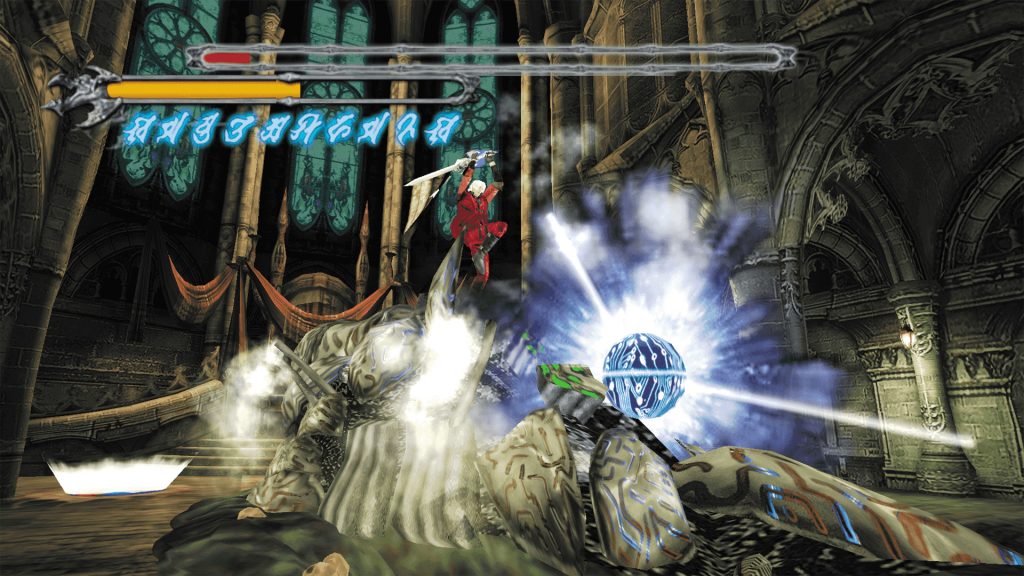
This experience became the defining moment of Hideaki Itsuno’s career. Feeling his name was attached to a product he wasn’t satisfied with, he was driven by a powerful desire for redemption. As he later recounted, the short development time for DMC2 meant he “couldn’t create a satisfying product,” which led directly to him asking to direct Devil May Cry 3. This wasn’t just another project for him; it was a personal mission.
Itsuno gathered a team of developers he considered “skilled but lacking work at the time” and rallied them with an inspiring call to arms: “how about you and I go leave our mark in the gaming industry?”. The team worked with a palpable “do or die” intensity, believing that “if this game didn’t succeed then it’s all over”. This immense pressure became the crucible in which one of the greatest action games of all time was forged.
Devil May Cry 3 was a point-by-point masterpiece of a comeback. It brought back a younger, cockier, and endlessly charismatic Dante, serving as a prequel that perfectly captured the spirit of Kamiya’s original vision. But Itsuno didn’t just restore the series; he evolved it in a way that would define its future. He introduced the revolutionary Style System, a mechanic that took the original’s philosophy of expressive combat and blew it wide open.
Developer’s Toolkit: The Four Styles of DMC3
The Style System was the most significant evolution of “stylish combat” in the series’ history, giving players four distinct gameplay philosophies to master and level up independently.
- Trickster: The Art of Evasion. Focused on unparalleled mobility, allowing players to dash, teleport, and wall-run to control the flow of battle and remain untouched. It was for the player who believed the coolest move was the one that was never landed on them.
- Swordmaster: The Art of the Blade. Massively expanded melee weapon movesets, giving players a vast arsenal of new combos and special attacks for maximum close-quarters creativity. This was for the player who saw the sword as their primary canvas.
- Gunslinger: The Art of the Firearm. Transformed Dante’s guns from secondary, combo-extending tools into primary weapons of destruction, with unique abilities and flair for every firearm. It empowered players who wanted to keep their distance but never sacrifice style.
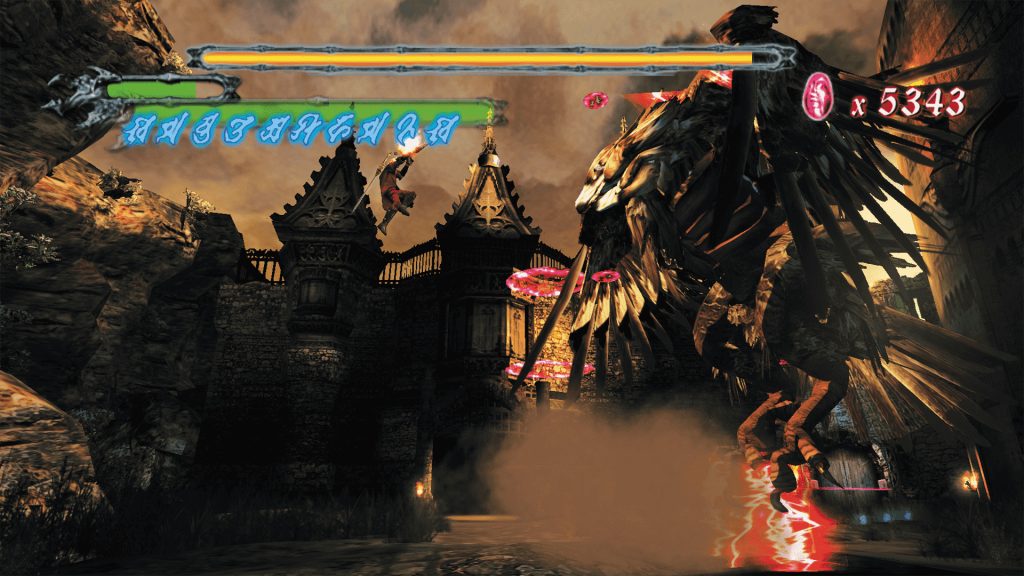
- Royalguard: The Art of the Perfect Defense. A high-risk, high-reward style centered on blocking and parrying enemy attacks at the last possible second to absorb their power and unleash it in a devastating counter-attack. This was the ultimate test of timing and nerve for the most confident players.
The brilliance of Devil May Cry 3 is inextricably linked to the experience of Devil May Cry 2. The “negative space” left by the second game—the muted protagonist, the simplified combat, the lack of a strong identity—provided Itsuno with a perfect blueprint of what to avoid. His personal and professional drive to redeem both himself and the franchise was the creative fuel that pushed Devil May Cry 3 to not only meet the original’s promise but to vastly exceed it. The existence of a less-than-perfect sequel was the necessary catalyst for the creation of a legendary one.
Part IV: Passing the Torch and Re-examining the Formula
The “Superman Problem” and the Rise of Nero
After the masterpiece that was Devil May Cry 3, the series faced a new challenge: what do you do with a protagonist who is already the coolest, most powerful guy in the room? This is the “Superman Problem,” and by the time Devil May Cry 4 began development, Dante was a fully realized demon-slaying master. To create a new sense of progression and to attract newcomers to the franchise, Capcom made a bold decision: they introduced a new protagonist, Nero.
This was a deliberate choice to give players a character who could grow and develop over the course of the game, starting from a place of relative weakness and gradually acquiring new powers. Nero was designed as a “characteristically wild, quite immature, young, and very passionate kind of a rebel”. His story was driven by a simple, almost Hollywood-esque motivation: his love for Kyrie and his desire to protect her, a theme inspired by the manga phrase “I love you, so I protect the city you love”. His gameplay was built around his unique demonic arm, the Devil Bringer, which allowed him to grapple enemies and perform powerful throws, giving him a distinct feel from Dante’s weapon-and-style-focused combat. The introduction of a new lead was met with some trepidation from fans, drawing comparisons to the controversial protagonist swap in Metal Gear Solid 2: Sons of Liberty, but Nero’s unique mechanics and earnest personality eventually won many over.
The Western Experiment: DmC: Devil May Cry
Following DMC4, Capcom, concerned that the series was becoming too niche and wasn’t connecting with a broader Western audience, decided on another bold experiment: a full reboot developed by a Western studio. They partnered with the UK-based Ninja Theory, a developer renowned for their cinematic storytelling and performance capture technology in games like Heavenly Sword and Enslaved: Odyssey to the West.
The resulting game, 2013’s DmC: Devil May Cry, was met with a fiercely divided reception, largely centered on the radical redesign of Dante. However, a crucial and often overlooked piece of context is that this redesign was a direct mandate from Capcom. Ninja Theory’s initial concept art was much closer to the classic Dante, but Itsuno and Capcom leadership pushed them to be more radical, to “Go crazy” and create something that truly felt new and different to justify the reboot’s existence. This reframes the narrative from “Ninja Theory misunderstood the character” to “Ninja Theory followed their partner’s explicit directive for a bold reinvention.”

The Value of Collaboration
Despite the controversy, the collaboration proved to be creatively valuable. Hideaki Itsuno himself was deeply involved, visiting the studio in Cambridge regularly and later praised their work, stating:
What they did with DmC, that art style, those animations, that is real style, y’know? So we took a lot of what we learned from that.
Hideaki Itsuno, Game Informer (August 24, 2018)
This “learning” wasn’t just talk. The mainline series directly adopted several of DmC‘s most polished presentation elements for Devil May Cry 5. These innovations included the dynamic style announcer calling out ranks in real-time, more linear and cinematic level designs that prioritized forward momentum, stylish slow-motion finishers on the last enemy in an encounter, and the way combat music would dynamically swell and fade with the action.
The period of DMC4 and DmC represents the franchise grappling with its own identity in the face of massive success. These games were necessary detours. They allowed the series to solve an internal narrative problem with the introduction of Nero and to absorb external design ideas from a talented Western collaborator. These weren’t side stories; they were crucial research and development phases that directly informed the masterful design of the series’ grand return.
Part V: The King is Back: The Modern Embodiment of Style
A Grand Synthesis
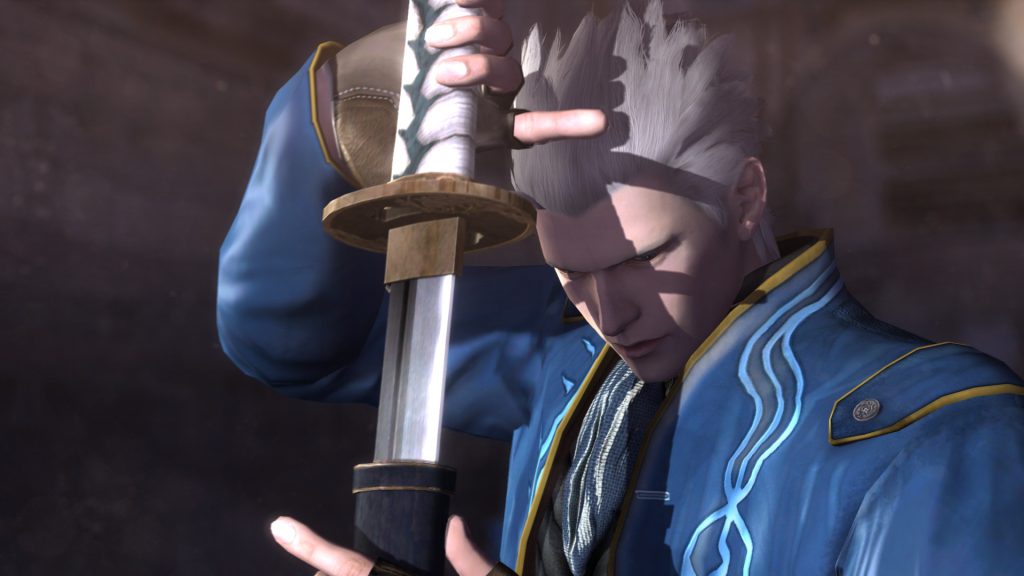
After a decade-long wait, Devil May Cry 5 arrived in 2019, and it was nothing short of a triumphant declaration. It felt like the confident culmination of everything the series had learned over its nearly 20-year history. It had the deep, expressive combat of DMC3, the dual-protagonist structure of DMC4, and the polished, cinematic presentation of DmC, all synthesized into a spectacular whole.
Three Masterful Playstyles
The game’s greatest achievement was its masterful execution of three completely distinct, yet equally deep, playable characters.
- Nero, Refined: Returning older and more mature, Nero’s gameplay was reimagined around the Devil Breaker system. These consumable prosthetic arms, each with a unique ability, replaced his old Devil Bringer and added a fascinating new layer of strategy and resource management to his combat. Players had to think about their loadout and when to sacrifice an arm for a powerful “Break Age” attack.
- Dante, Unleashed: Embodying Itsuno’s core design philosophy that “taking stuff away tends to upset people,” Dante returned as the ultimate Swiss Army knife of demon slaying. He had his largest-ever arsenal of melee and ranged weapons, and most importantly, could switch between all four of his signature styles on the fly. This was Dante at his absolute peak, a walking toolbox of stylish destruction that gave players unprecedented freedom.
- V, The Paradigm Shift: The game’s most audacious innovation was its third protagonist, the mysterious V. His creation stemmed from a simple but brilliant design concept from Itsuno: “taking what you need to protect and what you need to attack with and separating those two elements”. V himself is physically weak and vulnerable, a poet who walks with a cane. He fights by summoning three demonic familiars—the panther Shadow for close-range attacks, the eagle Griffon for ranged support, and the hulking golem Nightmare as his Devil Trigger—to do his bidding. The genius twist is that his familiars can weaken enemies but cannot kill them. To finish a foe, the player must expose the frail V by teleporting him into the fray to land the final blow with his cane, creating a unique and thrilling “delicate dance” of risk management, positioning, and micromanagement. This gameplay is a perfect example of ludonarrative harmony; as the story reveals V to be the literal human half of Vergil, his physical frailty becomes his core mechanic.
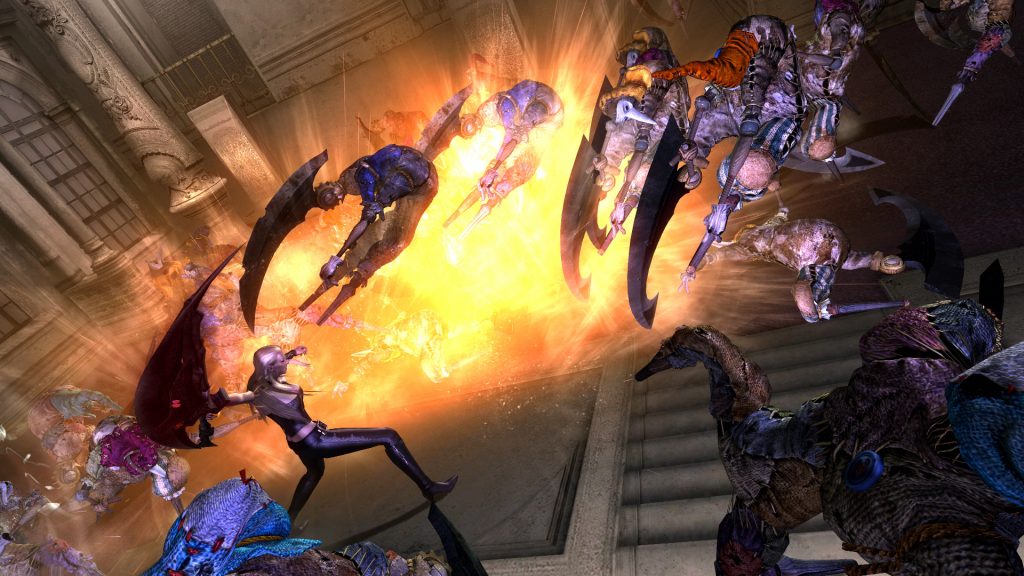
The design of V demonstrates a level of mastery that can only come from decades of defining and refining a genre. By deconstructing the fundamental action game loop—where a single character is both the agent of attack and the object of defense—and splitting it into separate entities, Itsuno’s team created something truly new. It’s proof that the series’ creators not only wrote the rules of stylish action but now know them so well that they can break them in brilliant and meaningful ways.
Photo-Realism Meets High Fashion
This mechanical brilliance was matched by a stunning leap in visual presentation, thanks to Capcom’s powerful RE Engine. The team aimed for a new level of photorealism, going so far as to hire tailors to create real-life, custom-made costumes for Nero, Dante, and V, which were then scanned into the game. This dedication to realism was blended with a high-fashion sensibility; the designers cited the adventurous, avant-garde work of Austrian designer Carol Christian Poell as a key inspiration for the game’s aesthetic, particularly in the use of materials and unique silhouettes.
Conclusion: The Enduring Legacy of Style
The journey of Devil May Cry is one of the most fascinating in all of gaming. It’s a story of accidental birth, genre-defining innovation, a near-death experience followed by a glorious redemption, and experimental detours that led to a triumphant return. It is a franchise built on the idea that how you play is just as important as whether you win.
Now, as the series stands at its creative peak, its legacy has become a living, breathing thing, with its future being actively debated by the very people who created it. The conclusion of this story pivots back to its beginning, with the series’ original creator, Hideki Kamiya. In recent years, Kamiya has been vocal about his desire to return to the world he first imagined. He wants to remake the original Devil May Cry.
This isn’t a wish born of pure nostalgia. Kamiya looks at his creation with a critical, modern eye. In a recent interview, he stated:
I’ve said this before, but I’d love to remake the first Devil May Cry. I think it’s a game that has a lot of room for improvement
Hideki Kamiya, IGN Japan (October 20, 2023)
His goal isn’t to simply update the graphics but to remake the game “from the ground up,” applying modern technology and his own evolved design philosophies to the classic formula. He has no concrete plans yet, but his passion is palpable. This creates a fascinating potential future for the franchise. The legacy of Devil May Cry is now so strong that it has two fathers, each with a compelling vision. One path lies with Hideaki Itsuno, the masterful steward who resurrected the series and evolved it to its current height of mechanical perfection. The other lies with Hideki Kamiya, the visionary creator who wants to return to his roots and radically reinvent the past. The fact that a game born from a happy accident over two decades ago can still inspire this level of passion and creative ambition in its own makers is the ultimate testament to its timeless, enduring, and smokin’ sexy style.
View Sources
- Devil May Cry – Wikipedia, accessed on June 17, 2025, https://en.wikipedia.org/wiki/Devil_May_Cry
- How the Original Resident Evil 4 Became Capcom’s Most Stylish Hack-n-Slash Franchise, accessed on June 17, 2025, https://www.cbr.com/resident-evil-4-devil-may-cry/
- Devil May Cry (video game) – Wikipedia, accessed on June 17, 2025, https://en.wikipedia.org/wiki/Devil_May_Cry_(video_game)
- Considering the history of DMC coming from a beta of RE4, you lot glad that they ended up becoming separate? : r/residentevil – Reddit, accessed on June 17, 2025, https://www.reddit.com/r/residentevil/comments/16e06na/considering_the_history_of_dmc_coming_from_a_beta/
- History Of: ‘Devil May Cry’ – Ball State Daily, accessed on June 17, 2025, https://www.ballstatedaily.com/article/2018/02/history-of-devil-may-cry?ct=content_open&cv=cbox_latest
- Devil May Cry director Hideki Kamiya Interview – SurvivHor, accessed on June 17, 2025, https://survivhor.biohazardfrance.net/morbidcreations/dmc_behind/int_hideki/dmc_int_hideki_3.htm
- As ‘Devil May Cry’ Turns 20, Bloody Disgusting Revisits its Origins …, accessed on June 17, 2025, https://bloody-disgusting.com/video-games/3679500/devil-may-cry-turns-20-bloody-disgusting-revisits-origins-influences/
- Devil May Cry And How Character Action Burst Onto The Gaming …, accessed on June 17, 2025, https://scriptroutine.com/2022/03/11/devil-may-cry-and-how-character-action-burst-onto-the-gaming-scene-in-style/
- Devil May Cry 5 Analysis – The Style Gauge – YouTube, accessed on June 17, 2025, https://www.youtube.com/watch?v=kwejxsAO4gQ
- Stylish Action: The Hints of Devil May Cry in Modern Gaming – Playsum, accessed on June 17, 2025, https://www.playsum.live/blog/stylish-action-the-hints-of-devil-may-cry-in-modern-gaming
- Devil May Cry and Ninja Gaiden: The Two Extremes of the Hack-and-Slash Genre, accessed on June 17, 2025, https://www.superjumpmagazine.com/devil-may-cry-ninja-gaiden-the-two-extremes-of-the-hack-and-slash-genre/
- Hack and slash – Wikipedia, accessed on June 17, 2025, https://en.wikipedia.org/wiki/Hack_and_slash
- So DMC 1 did basically invent the hack and slash genre as we know it today. – Reddit, accessed on June 17, 2025, https://www.reddit.com/r/DevilMayCry/comments/qq4if2/so_dmc_1_did_basically_invent_the_hack_and_slash/
- So, if DMC was the precursor to pretty much this whole genre… – Devil May Cry HD Collection – GameFAQs, accessed on June 17, 2025, https://gamefaqs.gamespot.com/boards/646887-devil-may-cry-hd-collection/62501292
- Devil May Cry 2 – Wikipedia, accessed on June 17, 2025, https://en.wikipedia.org/wiki/Devil_May_Cry_2
- What’s the story behind DMC2 development? : r/DevilMayCry – Reddit, accessed on June 17, 2025, https://www.reddit.com/r/DevilMayCry/comments/en62jl/whats_the_story_behind_dmc2_development/
- I’m playing Devil May Cry 2. What’s the story behind the development of this game? – Reddit, accessed on June 17, 2025, https://www.reddit.com/r/DevilMayCry/comments/1i7zr7i/im_playing_devil_may_cry_2_whats_the_story_behind/
- en.wikipedia.org, accessed on June 17, 2025, https://en.wikipedia.org/wiki/Devil_May_Cry_2#:~:text=Devil%20May%20Cry%202%20was%20conceived%20as%20happening%2010%20years,to%20a%20non%2Dcompany%20writer.
- Devil May Cry 2 Has Been a Cautionary Tale For 20 Years – Game Rant, accessed on June 17, 2025, https://gamerant.com/devil-may-cry-2-flawed-important-game-20-year-anniversary/
- Hideaki Itsuno (designer of DMC3/SE and DMC4) wasn’t responsible for DMC2. – DmC: Devil May Cry – GameFAQs, accessed on June 17, 2025, https://gamefaqs.gamespot.com/boards/605600-dmc-devil-may-cry/59388953
- Itusno-San Famitsu Interview of 20th ann in Japanese someone …, accessed on June 17, 2025, https://www.reddit.com/r/DevilMayCry/comments/qls3wz/itusnosan_famitsu_interview_of_20th_ann_in/
- DMC3 Dante design philosophy : r/TwoBestFriendsPlay – Reddit, accessed on June 17, 2025, https://www.reddit.com/r/TwoBestFriendsPlay/comments/1f8p9em/dmc3_dante_design_philosophy/
- Nero (Devil May Cry) – Wikipedia, accessed on June 17, 2025, https://en.wikipedia.org/wiki/Nero_(Devil_May_Cry)
- Devil May Cry 4 – Wikipedia, accessed on June 17, 2025, https://en.wikipedia.org/wiki/Devil_May_Cry_4
- I love Nero but I preferred his DMC4 version. How about you? : r/DevilMayCry – Reddit, accessed on June 17, 2025, https://www.reddit.com/r/DevilMayCry/comments/1iits04/i_love_nero_but_i_preferred_his_dmc4_version_how/
- Nero = the DMC equivalent of MGS2’s Raiden – Devil May Cry 4 – GameFAQs, accessed on June 17, 2025, https://gamefaqs.gamespot.com/boards/928376-devil-may-cry-4/41349300?page=3
- why was dmc4 rushed? : r/DevilMayCry – Reddit, accessed on June 17, 2025, https://www.reddit.com/r/DevilMayCry/comments/15h21jk/why_was_dmc4_rushed/
- Ninja Theory Developer Dominic Matthews Details Capcom DMC Devil May Cry Reboot, accessed on June 17, 2025, https://www.youtube.com/watch?v=wocgc6Btm6Y
- Over the weekend, I wrote a Hobby Drama post on DmC Devil May, covering its troubled development and the saga that followed it. Thought I’d share it here for anyone looking for the story of the reboot in full! : r/DevilMayCry – Reddit, accessed on June 17, 2025, https://www.reddit.com/r/DevilMayCry/comments/j5gmk0/over_the_weekend_i_wrote_a_hobby_drama_post_on/
- Ninja Theory and Capcom Reboot Devil May Cry with Unreal Engine 3, accessed on June 17, 2025, https://www.unrealengine.com/pt-BR/blog/dmc-devil-may-cry
- Capcom’s Hideaki Itsuno On Ninja Theory, Nico, And The Difference Between Dante And Nero – Game Informer, accessed on June 17, 2025, https://www.gameinformer.com/gamescom-2018/2018/08/24/capcoms-hideaki-itsuno-on-ninja-theory-nico-and-the-difference-between
- 5 Things DMC 5 Learned From DmC: Devil May Cry – Rely on Horror, accessed on June 17, 2025, https://www.relyonhorror.com/articles/5-things-dmc-5-learned-from-dmc-devil-may-cry/
- Dante returns: Hideaki Itsuno on Devil May Cry 5 | Eurogamer.net, accessed on June 17, 2025, https://www.eurogamer.net/dante-returns-itsuno-on-devil-may-cry-5
- Devil May Cry 5’s new character V plays unlike any other in the …, accessed on June 17, 2025, https://www.alienwarearena.com/ucf/show/1981139/boards/gaming-news/News/devil-may-cry-5s-new-character-v-plays-unlike-any-other-in-the-series-hands-on
- Devil May Cry 5 – Wikipedia, accessed on June 17, 2025, https://en.wikipedia.org/wiki/Devil_May_Cry_5
- V: The Quintessential Human (AKA my character analysis of V) : r/DevilMayCry – Reddit, accessed on June 17, 2025, https://www.reddit.com/r/DevilMayCry/comments/jl2nx6/v_the_quintessential_human_aka_my_character/
- ‘Devil May Cry 5’: How Capcom Created Dante & Nero’s Style – Highsnobiety, accessed on June 17, 2025, https://www.highsnobiety.com/p/devil-may-cry-5-fashion-interview/
- Hideki Kamiya Wants to Remake the Original Devil May Cry, Would Make Design Changes, accessed on June 17, 2025, https://www.pushsquare.com/news/2025/05/hideki-kamiya-wants-to-remake-the-original-devil-may-cry-would-make-design-changes
- Hideki Kamiya Would “Love” To Remake Devil May Cry “From The …, accessed on June 17, 2025, https://screenrant.com/hideki-kamiya-devil-may-cry-remake-interest/