In the landscape of video games, few titles resonate with as much power and legacy as Blizzard Entertainment’s Diablo. Released on December 31, 1996, Diablo not only defined a genre but also forged a path for future action RPGs and online multiplayer experiences. The narrative of Diablo is as compelling as the game itself, filled with creative innovation, ambitious design, and a dedication to delivering a unique dark fantasy experience that has influenced countless titles since.
Stay awhile and listen
If we want to learn about the origins of Diablo, we must go back even further to the year 1995 and the game Justice League Task Force. It may be hard to believe it, but Diablo may have never been developed without Justice League. All because of a decision of Sunsoft to handle the production of the game for SNES to a small company called Silicon & Synapse while at the same time handling the version for GENESIS to another company – Condor. All this without telling either company about the other. Everything came to the forefront when David Brevik (Condor) went to CES during game development and discovered that another company was making SNES version. What caught Brevik’s attention was how similar the two versions were, even though there was no contact between the companies. This one observation sparked a dialogue between Brevik and Silicon & Synapse. Brevik saw that maybe he found someone who could share his vision for a game.
You see, by the point of CES meeting, Brevik was already turned down multiple times while pitching his new RPG game idea. What he heard repeatedly was that the RPG genre is dead, and no one is playing it.
We have been pitching Diablo for several years at this point and we got rejected over 20 times by people that weren’t interested. The theme at the time was ‘RPGs are dead. Nobody will ever make another RPG again.
David Brevik
Games Gathering 2019
But Brevik had a vision and wanted the game to be made, so he took one last chance – he asked Silicon & Synapse if he could pitch the idea to them. Fortunately, they said yes, but just asked him to wait until they were done with a game they were making – the first Warcraft.
Your turn, Diablo
Reading the pitch document, we can clearly see, that from the start the game was just as we know it now, but with a major twist. Just look at this fragment depicting the base of the game:
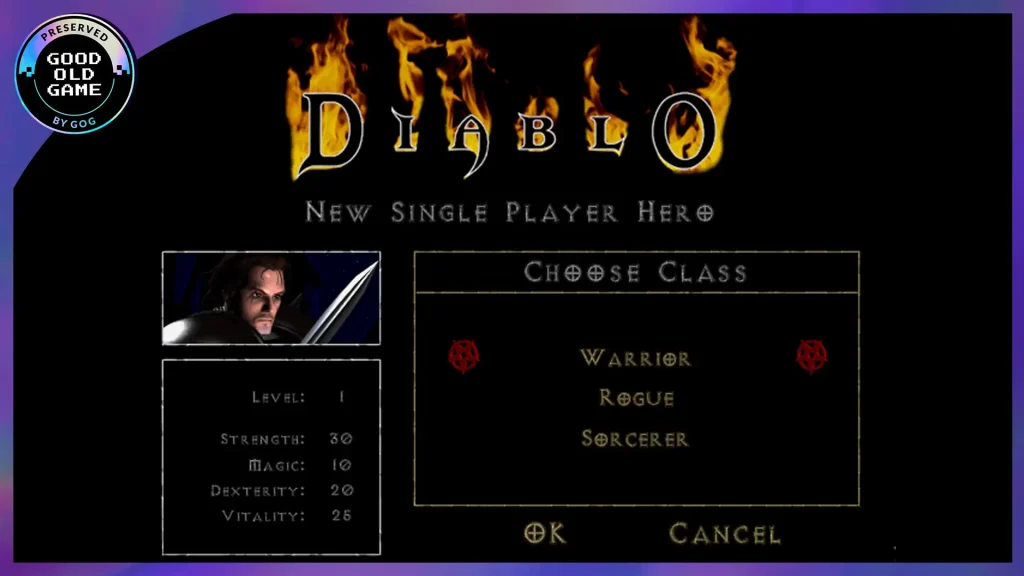
All the action takes place in an isometric, three-quarter perspective, with diamond-shaped ‘square’ floor spaces. The entire game operates on a turn-based system. Using a mouse, the player moves his character from space to space.
Diablo Pitch Document
Condor, Inc.
Yes! Brevik’s original plan was to have Diablo turn-based. This decision seemed obvious, as a lot of inspiration for Diablo came from the original X-COM game, starting from the isometric view. Brevik stated in a presentation during Games Gathering 2019 that the isometric setting was done by taking a screenshot of an X-COM screen and transferring it to Diablo. Originally, Diablo was supposed to feature an X-COM styled selection box. There is no surprise in that case that the turn-based system was to be present aswell. But after Silicon & Synapse (now renamed Blizzard Entertainment) picked the game, they suggested one edit – “make it real-time instead of turn-based”.
David Brevik recalls that nearly everyone was for the idea, except for him. He was the one strongly opposed party to that idea and stayed late to code it to prove to people that it’s not better. And then he played it.
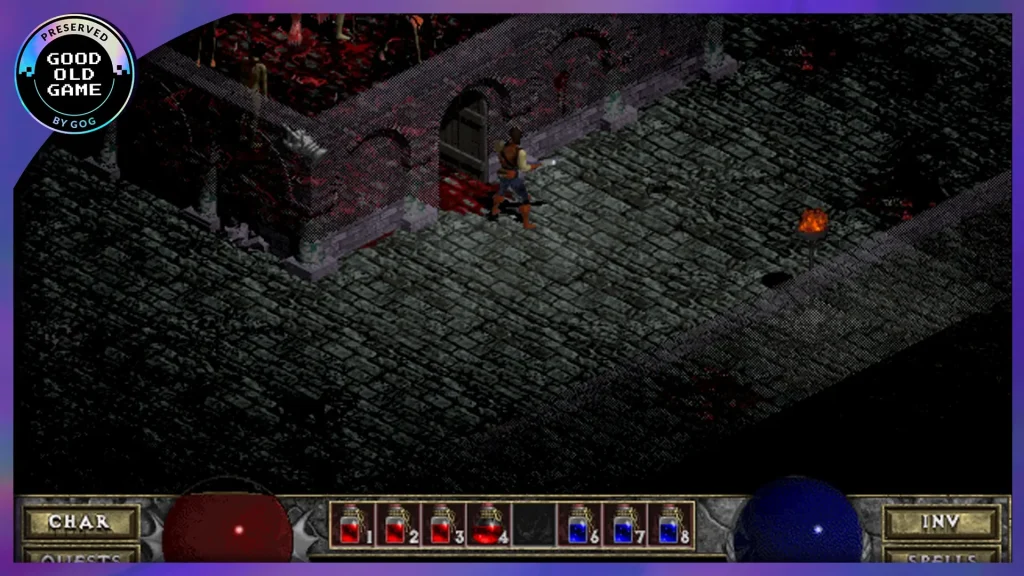
I clicked on a skeleton on the screen, and my character walked over and swung over and smacked this skeleton apart. And I was like ‘OH MY GOD, THIS IS AMAZING, THAT FELT SO GOOD. THIS IS WAY BETTER!’
David Brevik
Ars Technica Interview
Apparently that one play session was enough for Brevik to change his tune entirely and be all for real-time gameplay. You could say that this one evening of David Brevik playing real-time Diablo was the birth of the ARPG genre.
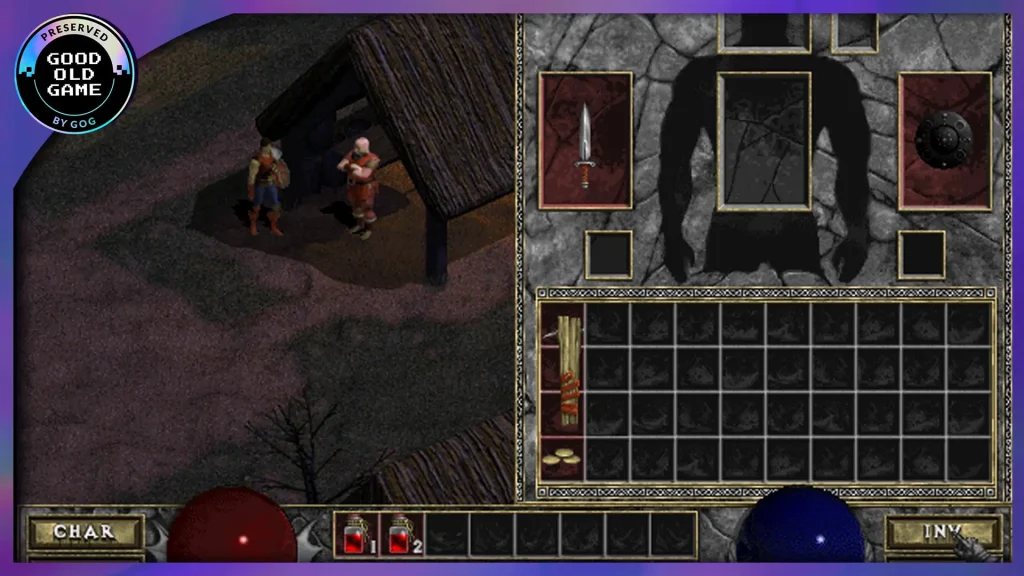
Of course there were more hoops on the way. One design idea that was considered was making Diablo as claymation. Fortunately, after just one mob, the team decided that it was way too expensive and time-consuming and dropped the idea.
But that was not the end of Condor’s struggles. Soon a major hurdle arose – money. Apparently, the team was so excited to finally be able to develop the game, they agreed to do it for $300,000, which was not enough with 15 people and studio expenses. Eventually Blizzard approached Condor with an offer to acquire them and turn into Blizzard North. But another company – 3DO – caught wind of that and came to Condor with the same offer, but for twice the money.
3DO was offering us twice as much money, and we turned them down, because we felt that Blizzard really got us, and got the game.
David Brevik
Game Developer Conference, 2016
With that decision, Condor was acquired and turned into Blizzard North and Diablo could see the light of day. But it is interesting to think about how history would look like if 3DO managed to convince Brevik to go with them. Would Diablo be a totally different game? And how would that influence 3DO’s own series – Might and Magic.
That one decision might have changed a lot of gaming history and allow for not only Diablo to exist, but also another fan-favourite game (that is coincidentally also a part of GOG Preservation Program) – Heroes of Might and Magic III.
How the history would change we will never know. But it’s interesting and fun to think about it.
Innovative Gameplay Mechanics
So why were both Blizzard and 3DO so interested in Diablo, and why was it a commercial success? Two main factors were involved: innovative systems and the story told inside the game.
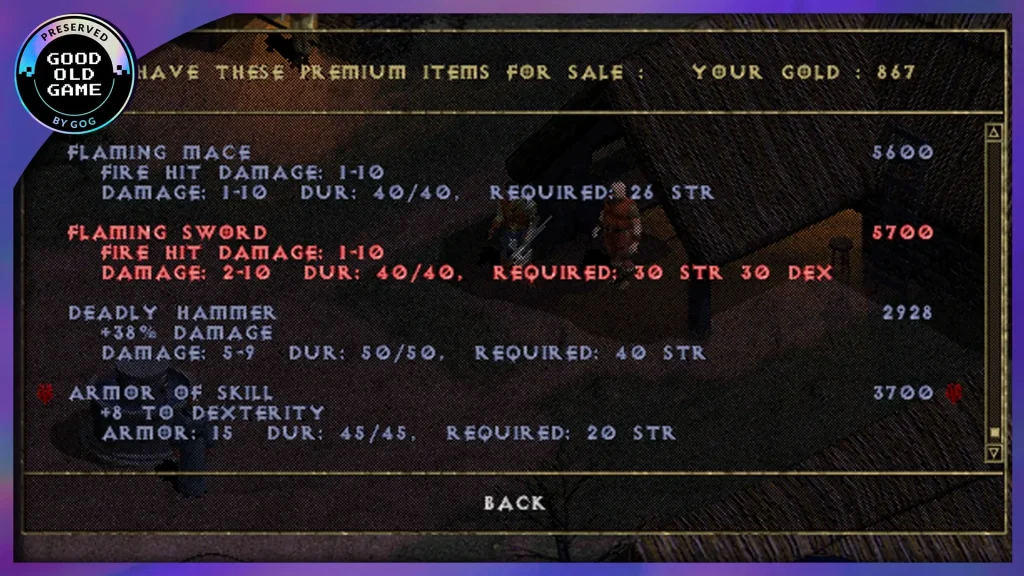
Diablo revolutionized gameplay mechanics in several significant ways. One of the most influential features was its use of procedurally generated levels. Instead of locking players into a linear experience with fixed maps, each playthrough offered a unique set of environments and encounters, ensuring no two adventures were the same. This unpredictability enhanced replayability, a concept that became central to the game’s success.
The loot system introduced in Diablo was groundbreaking. Players were rewarded with random weapon and armor drops of various rarities, many carrying unique powers. Each mob kill prompted a random roll determining if anything drops and what it will be – gold, armor, weapon, even the rarity. This way each mob kill, each destroyed barrel and opened chest was not only filled with loot, but mostly excitement.
The integration of multiplayer functionality through Blizzard’s Battle.net was another game-changer. While online play was not entirely new, Diablo delivered a seamless experience where players could join or host games, trade items, and cooperate or compete in real-time. This feature laid the groundwork for what would later become a staple in modern gaming—online multiplayer experiences.
Even the story told in Diablo was amazing. It wasn’t just a story confined in the game, but a part of something bigger. Each conversation in-game added something new about what happened, about the denizens of Tristram and even about the world beyond what the game showed us. After the success of the game, we could also dive into books, stories, animations and other types of media and learn about the bigger lore. This all showed us that the story in Diablo was just a tiny part of the bigger world and expansive lore. It was thanks to the story told in first Diablo that we got sequels and are currently on Diablo IV and diving even deeper into the lore of Sanctuary and Eternal War.
Inspired by darkness
Upon its release, Diablo became a commercial and critical success. While it faced some criticism regarding the repetitive nature of its gameplay towards the game’s latter stages, the overall reception was overwhelmingly positive. It was lauded for its atmospheric design, immersive storytelling, and addictive gameplay. The game sold over two million copies in its first few years, establishing itself as a pioneer and a cultural phenomenon.
The legacy of Diablo continues to echo throughout the industry. Titles such as Titan Quest, Torchlight, Path of Exile, Grim Dawn, and the Dark Souls series bear witness to its influence, adopting and refining many of the mechanics that Diablo introduced. The grinding for rare items, random loot rolls, procedurally generated levels and the cooperative multiplayer experience pioneered in Diablo are now common staples in RPGs and action-adventure games. Furthermore, sequels like Diablo II and Diablo III expanded upon the original’s foundation, solidifying the franchise as a pillar of the action RPG genre.
The intoxicating allure of battling evil, combined with a uniquely dark aesthetic, defined not only the Diablo series but also set a benchmark for all fantasy games to come. As gamers continue to explore the depths of hell with each new installment, the legacy of Diablo endures, reminding us of its haunting birthplace in the shadows of game development history.
Which company developed Diablo?
Blizzard North, which was responsible for the creation and development of the original Diablo game, was a subsidiary of Blizzard Entertainment. Before becoming Blizzard North, the company was known as Condor and was acquired by Blizzard Entertainment in 1996.
Who created Diablo?
The original concept for Diablo was created by David Brevik, with significant contributions from Max and Erich Schaefer. Together, they played pivotal roles in shaping the game’s design and direction.
What is the original release date of Diablo?
The original release date of Diablo was December 31, 1996. The game was launched just in time for the new year and quickly became a critical and commercial success.
What type of game is Diablo?
Diablo is an action role-playing game (ARPG). It features real-time combat, character progression through leveling and skill development, and a strong emphasis on looting and item management. The game’s dark fantasy setting and engaging storyline make it a standout title in the genre.
What is the story of Diablo 1?
The story of Diablo 1 revolves around the town of Tristram and the impending doom brought about by the demon lord Diablo. Players descend into the depths of the Tristram Cathedral, battling through various levels of monsters and discovering the dark secrets of the world of Sanctuary. The ultimate goal is to confront and defeat Diablo, who seeks to enslave humanity.
What are the Diablo games about?
The Diablo games are set in the dark fantasy world of Sanctuary, where players battle against the forces of evil led by the Prime Evils (Diablo, Mephisto, and Baal). The games focus on hack-and-slash combat, character progression, and collecting powerful loot. Each installment expands the lore, introduces new characters and classes, and deepens the overarching storyline of the eternal struggle between good and evil.
What are all the Diablo games?
The main games in the Diablo series are:
Diablo (1996)
Diablo: Hellfire (1997, expansion)
Diablo II (2000)
Diablo II: Lord of Destruction (2001, expansion)
Diablo III (2012)
Diablo III: Reaper of Souls (2014, expansion)
Diablo IV (2023)
Diablo IV: Vessel of Hatred (2024, expansion)
Additional spin-off and mobile games include Diablo Immortal.