
If you're an avid gamer, you might have encountered the term "DRM" mentioned in various contexts before. But is it something that warrants your attention? Indeed, it is – especially if you cherish the freedom to enjoy gaming without restrictions, prioritize your privacy, and believe in the ownership rights of the digital content you purchase – then it's crucial to be aware of DRM. We aim to explain precisely what DRM entails and how it impacts you in the most straightforward manner possible. Let's dive in!
What in the world is DRM?
DRM stands for Digital Rights Management. It’s a type of technology implemented by game companies to regulate and control the manner in which you utilize the games you purchase. Think of it as a sophisticated lock that prevents individuals from playing the games they have legally acquired in methods that the company deems undesirable or unauthorized.
Essentially, when you buy a game that incorporates DRM, you’re not merely obtaining the game itself – you’re also acquiring a comprehensive set of rules and restrictions concerning how, when, and where you are permitted to play it.
Why should I care?
The reason you should care about DRM is that it can significantly interfere with how you enjoy your games. In some cases, even though you’ve paid for the game, you’re still at the mercy of the DRM system to determine if, when, and how you can play. DRM can create barriers for you, a legitimate user, which feels unfair, especially when you just want to relax and play a game without unnecessary restrictions or interruptions.
By understanding how DRM works and how it might affect you, you can make more informed choices about where you buy your games and why DRM-free options are very much worth considering. Being aware of these issues allows you to support platforms and developers that respect user rights and offer more freedom in how you use the products you purchase.
How exactly does it affect me?
On the surface, Digital Rights Management (DRM) might appear to be a minor issue, but it has the potential to impact you in various significant ways. These effects are often not immediately apparent, and you might only become aware of them when you are in the process of playing or attempting to play a game. Here are some typical scenarios where DRM can influence your gaming experience:
Forced requirement for an Internet connection
One of the most prevalent types of Digital Rights Management (DRM) systems requires a constant internet connection, even when you are playing single-player games. While it is true that in today’s digital era, people are generally connected to the internet most of the time, this requirement can become extremely frustrating if:
- Your Internet connection is down or unstable – Imagine you’re about to dive into your favorite single-player game. You’ve got all your favorite snacks and drinks ready, and you just want to relax and unwind without a care in the world. Then, out of nowhere, the Internet goes out. Suddenly, you can’t play the game you’ve paid for, even though it doesn’t require any online features to function. In short, the thing you were eagerly anticipating is completely ruined.
- You’re traveling – If you find yourself on a flight or in a location where Wi-Fi is unavailable, you might be unable to play the game due to its Digital Rights Management (DRM) system, which requires an internet connection to “phone home” and confirm that you are indeed the legitimate owner of the game. It’s worth emphasizing that this verification process is necessary even though you have already purchased the game with your own money.
Of course, those are just two very common examples. Various other factors can also lead to sudden disruptions in your ability to play games, such as a lack of signal, which might occur if you are in an area with poor coverage, or an overloaded network, which can happen during peak usage times when many people are online simultaneously. Additionally, issues with your Internet provider, such as maintenance work or technical difficulties, can cause interruptions. Connection outages might arise due to unforeseen circumstances, while hardware problems, such as a faulty router or modem, can also impede your gaming experience. Moreover, extreme weather conditions, like severe storms or heavy snowfall, have the potential to affect connectivity by damaging infrastructure or causing power outages—all of these factors can contribute to unexpected gaming interruptions.
Limited Installations
Some Digital Rights Management (DRM) systems impose limitations on the number of times you can install a game or the specific locations where it can be installed. These restrictions can become quite complicated and troublesome for game owners, particularly in circumstances such as:
- PC upgrades – If you upgrade your PC by changing critical hardware components such as the motherboard or the hard drive, Digital Rights Management (DRM) systems might mistakenly identify it as a “new” computer, potentially preventing you from reinstalling the game.
- Switching between devices – If you are planning to enjoy the game on both your desktop and laptop, be aware that certain DRM (Digital Rights Management) systems might restrict the number of devices on which the game can be installed. In cases where you have already reached the maximum number of permitted installations, it may be necessary to get in touch with customer support for assistance or, in some cases, purchase an additional copy of the game.
- Reinstalling the game – In certain situations, such as when you have to reinstall the game several times due to a complete system reset or recurring technical problems, it is possible that Digital Rights Management (DRM) restrictions may be activated, which could prevent you from being able to access the game.
All of those unfortunate issues typically arise when games incorporate Digital Rights Management (DRM) systems.
Server shutdowns
Many video games incorporate Digital Rights Management (DRM) systems that depend on online servers to verify the authenticity of your purchased copy. If these servers become unavailable, whether due to temporary technical issues or permanent shutdowns, you might lose the ability to play the game. Such scenarios can occur in various situations, including:
- Older games – Several games that have been around for a number of years might experience the deactivation of their DRM (Digital Rights Management) servers by the company responsible for them. This is particularly likely if the game has lost its popularity and no longer attracts a significant player base. In such cases, when you attempt to play these games, you might encounter an issue where the game fails to launch because it is unable to confirm your ownership due to the absence of the DRM verification process.
- Game publishers closing – If a game publisher or developer faces financial difficulties and ultimately goes out of business, they may decide to shut down their servers completely. For games that incorporate Digital Rights Management (DRM) and require an online check-in process to authenticate the user’s access, this situation means that the game becomes inaccessible and is essentially lost to players forever.
Performance issues
Digital Rights Management (DRM) systems can occasionally lead to performance issues due to their constant operation in the background while you are engaged in gaming. These systems continuously utilize your computer’s resources, which can ultimately lead to the following consequences:
- Slower load times – Many Digital Rights Management (DRM) systems perform checks on files or authenticate your game during the loading process. This additional step can significantly extend the time it takes for your game to load, making the wait noticeably longer and potentially affecting the overall gaming experience.
- Gameplay stutters – If DRM technology requires periodic communication with its servers during gameplay, this could potentially lead to the game experiencing interruptions such as stuttering or pausing. These issues are particularly likely to occur if the internet connection is either slow or temporarily disrupted.
- Impact on frame rates – In rare instances, DRM systems might consume a significant portion of your computer’s resources, which can potentially impact the frame rate. This affects how smoothly the game operates, thereby making your gaming experience less enjoyable and possibly leading to noticeable lag or interruptions during gameplay.
DRM crashes or glitches
Digital Rights Management (DRM) is not without its imperfections, and there are occasions when it can fail to function properly. Instances of these malfunctions include:
- False positives – There is a possibility that the Digital Rights Management (DRM) system could erroneously identify your game as a pirated version, despite the fact that you have purchased it legitimately. This error can result in you being unable to access your game until you either reach out to customer support for assistance or resolve the problem through troubleshooting.
- Compatibility problems – Some DRM software can be incompatible with specific operating systems or hardware configurations, leading to a range of issues such as system crashes, error messages, or even completely blocking the game from starting up.
- Conflicts with other software – There are instances where DRM systems may interfere with other software installed on your computer. This interference can occur with antivirus programs that are designed to protect your system from threats, or with various background processes that are running simultaneously. Such conflicts can result in unexpected crashes or a range of other technical issues that disrupt your computing experience.
Bans and restrictions
Some Digital Rights Management (DRM) systems link your game license to an online account, such as those provided by platforms like Steam, Origin, or Uplay. If any problems arise with your account, whether it be a ban, a payment complication, or a security breach resulting in a hacked account, you could potentially lose access to your entire collection of games. This restriction would not be limited to just the individual game associated with the DRM but could extend to your whole library. In essence, this means:
- Account bans – If your account is banned, even if it happens by mistake, you may be completely locked out of accessing all the games associated with that account, especially those that utilize the DRM linked to it.
- Region restrictions – Some DRM systems impose restrictions based on geographical regions, which means that if you relocate to another country or attempt to play your game while traveling internationally, you may encounter blocks preventing you from accessing your game.
DRM-free? How do I get it?
Now, here’s where things get interesting. At GOG, we strongly dislike the fact that your freedom to enjoy gaming can be restricted, that you might lose access to the games you have paid for, and that there is often a lack of respect for your need to truly own what you purchase.
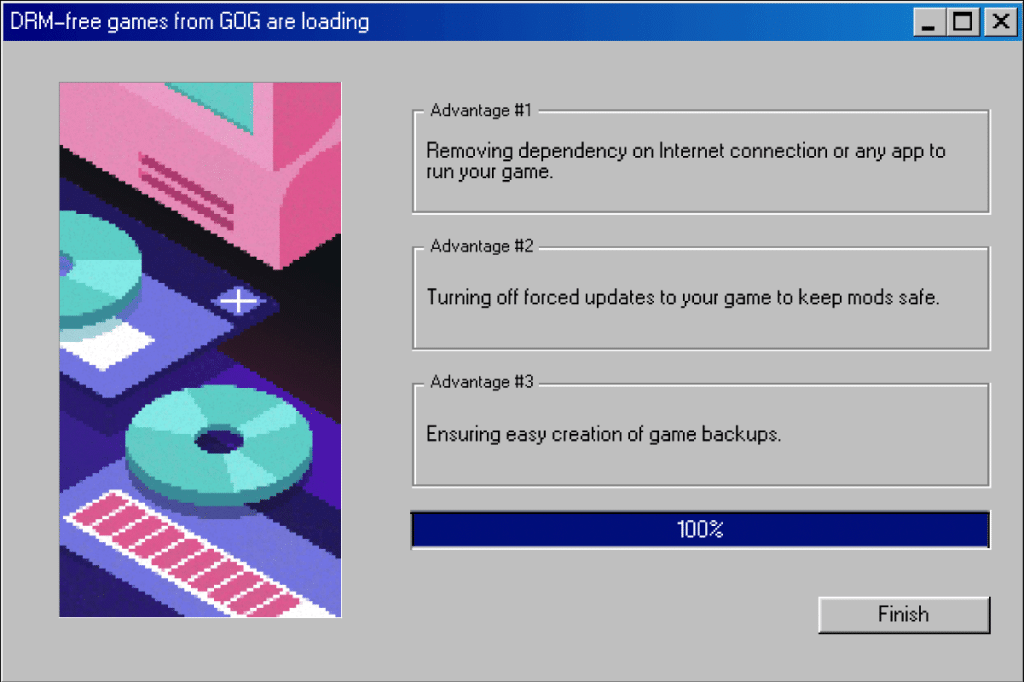
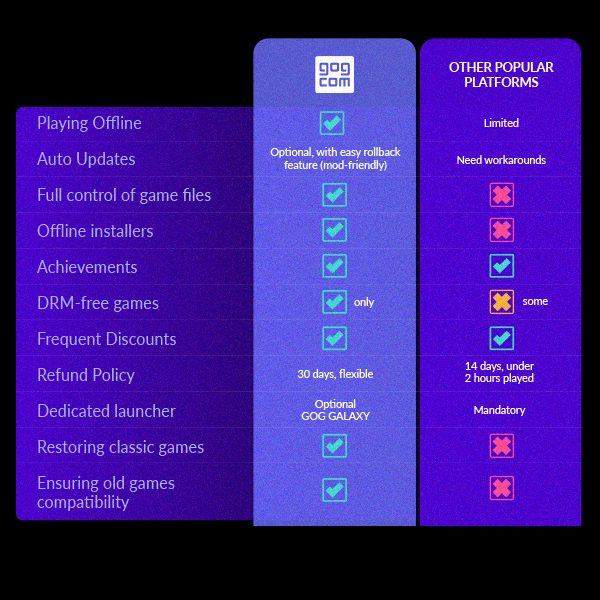
That’s why we are fully committed to providing you exclusively with DRM-free games. This ensures you don’t have to be concerned about any of the issues or limitations we just mentioned. When you purchase a DRM-free game on GOG, you have the freedom to play it offline at any time, back up its files for security and video game preservation, install it on as many devices as you wish, decide whether to use a launcher or run it directly from the executable files, and even skip any updates that you do not prefer. We do this because we respect you both as a gamer and as an individual.
Conclusion and FAQ
DRM (Digital Rights Management) might seem harmless at first glance, but it can severely restrict the way you enjoy your games by imposing various limitations. It can force you to maintain an online connection to play, even for games designed to be single-player, limit the number of times you can install them on different devices, and even lock you out entirely if a company decides to shut down its servers or chooses to revoke your access for any reason. In many situations, you don’t fully own the game – you’re merely playing by the rules they set, which can change unpredictably at any time.
In contrast, DRM-free games, like those available on platforms such as GOG, offer a completely different experience. They provide you with full freedom to play offline whenever you choose, allow you to install the game as many times as you want across multiple devices, and respect your need for ownership of the products you have paid for (which should always be the case). There are no restrictions, no hidden rules – just gaming on your terms. If you value having control over what you’ve invested in, opting for DRM-free games is the way to go.
What is DRM?
DRM, which stands for Digital Rights Management, is a form of technology implemented by game companies to regulate and manage the way consumers utilize the games they purchase. This system is designed to protect intellectual property rights by ensuring that games are used in accordance with licensing agreements and to prevent unauthorized distribution or copying of digital content.
How does DRM affect me?
Digital Rights Management (DRM) can significantly restrict your gaming experience by limiting your ability to play games offline, imposing restrictions on the number of installations, and potentially causing performance issues. Furthermore, DRM can even lock you out of your purchased games entirely if the servers are shut down or become inaccessible.
Why should I care about DRM?
Digital Rights Management (DRM) can significantly hinder your gaming experience by imposing restrictions that affect how you interact with your purchased games, potentially limiting your sense of ownership and control over the content you have legally acquired.
Can DRM cause performance issues in games?
Yes, Digital Rights Management (DRM) can sometimes lead to slower load times, cause gameplay stutters, and negatively affect frame rates because of the various background processes it requires. These processes are designed to prevent unauthorized access and distribution of digital content, but they can consume system resources, impacting the overall performance of games or applications.
What happens if a DRM server shuts down?
If a Digital Rights Management (DRM) server becomes unavailable or is permanently shut down, you might lose access to the game you purchased, particularly if the game necessitates online verification to confirm your ownership or to enable gameplay features.
Does DRM affect my ability to play single-player games?
Yes, certain Digital Rights Management (DRM) systems require an active internet connection, even when playing games that are specifically designed for a single-player experience. This means that players must be online to verify their access rights and ensure the game is legitimate, which can be inconvenient for those who wish to play offline or in areas with unreliable internet access.
What are some examples of DRM restrictions?
Digital Rights Management (DRM) restrictions may encompass a variety of limitations such as a cap on the number of times software can be installed, requirements that necessitate a constant internet connection to access content, and geographical restrictions that prevent users from accessing certain digital products based on their location.
What is DRM-free?
DRM-free indicates that a game is devoid of any Digital Rights Management, which means there are no restrictions imposed by the publisher or developer on how you can use the game. This grants you complete ownership and control over the game, allowing you to install, copy, and play it on any compatible device without limitations or the need for online authentication.
Where can I find DRM-free games?
Visit our online store at GOG.COM where you can explore an extensive collection of DRM-Free games. This ensures that you have complete ownership and the freedom to enjoy playing your games without any limitations or restrictions.




Testing